
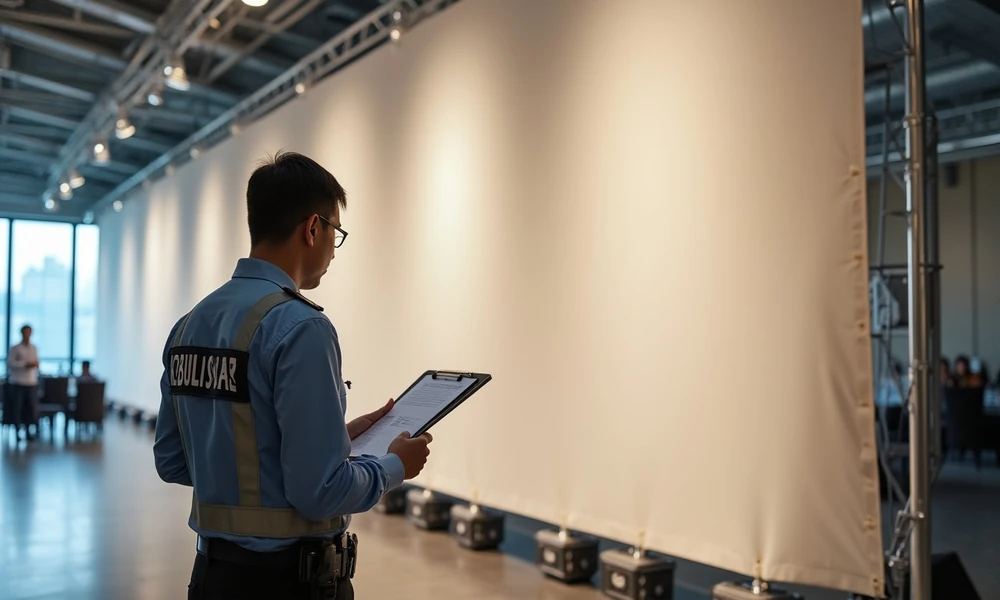

Venue safety inspections happen at the worst possible moment, during build when everything else is also running late, and if a structure fails, one has very few options. Modifying on site is rarely practical, and the alternative is an activation that does not open. What makes this frustrating is that almost every failure traces back to something decided weeks earlier at the design or fabrication stage, when correcting it would have cost nothing. Five signs suggest a photo booth backdrop in Singapore is heading toward a problem, and all of them are visible before anything is loaded onto a truck.
1. No Flame-Retardant Certification for the Materials Being Used
Venues generally require documentation that fabrics, panels, and finishes meet flame-retardant standards, and the certificate needs to exist before the build rather than being produced afterwards.
Ask which specific materials are being used and request the certification at the design stage. A contractor who cannot produce it, or who says the material is treated without documentation, is heading toward an inspection they will not clear. Spray-applied treatments are sometimes accepted and sometimes not, which is worth confirming with the venue rather than assuming.
2. A Design With No Clear Stability Calculation Behind It
Freestanding structures need to stay upright under lateral force, and that is an engineering question rather than a judgement. Tall, narrow, or top-heavy designs are particularly exposed.
Ask how stability has been calculated, what the ballast or counterweight arrangement is, and whether the figures have been documented. A reputable exhibition contractor in Singapore working on a structure of any height will have this information and should provide it without being pressed, because venues increasingly ask for it and a contractor producing a design without it has not anticipated the question.
3. Ballast or Weighting That Only Appears in the Final Drawings
Where weighting is added late, after the visual design is approved, it frequently does not fit. Ballast takes floor space, adds considerable weight, and has to be concealed, and retrofitting it to an approved design usually compromises either the appearance or the footprint.
Weighting should be part of the structural concept from the start rather than an adjustment made once someone asks the question.
4. No Account Taken of How the Public Will Interact With It
A photo activation is touched, leaned on, and crowded around for hours by people paying no attention to the structure. That is quite different from a display nobody approaches.
Check whether the design accounts for people pressing against it, whether edges and corners present any hazard at head height, whether cabling is routed where nobody walks, and whether anything could be pulled or climbed. Venues assess this, and a design that looks elegant and assumes respectful distance tends to attract questions.
5. Electrical Work Without Documentation or a Qualified Installer
Illuminated elements bring electrical requirements, and venues typically require work carried out by appropriately qualified people with documentation to match.
Ask who is doing the electrical installation, what certification covers it, how cabling is protected and routed, and whether the load has been confirmed against the available supply. Improvised wiring is among the fastest routes to a failed inspection.
Getting the Paperwork Assembled Before Build Week
The practical safeguard is requesting a compliance pack from the contractor well ahead: material certificates, stability calculations, electrical documentation, and a layout showing the actual footprint including ballast.
Sending that to the venue for review before fabrication begins turns a potential build-day failure into a design-stage comment. Contractors who work regularly in the venues concerned usually do this as a matter of course, and one who treats it as an unusual request is worth watching more closely as the date approaches.
Contact Sui Generis Neon to review your activation design against venue safety requirements before fabrication begins.
